What is an MCP context server?
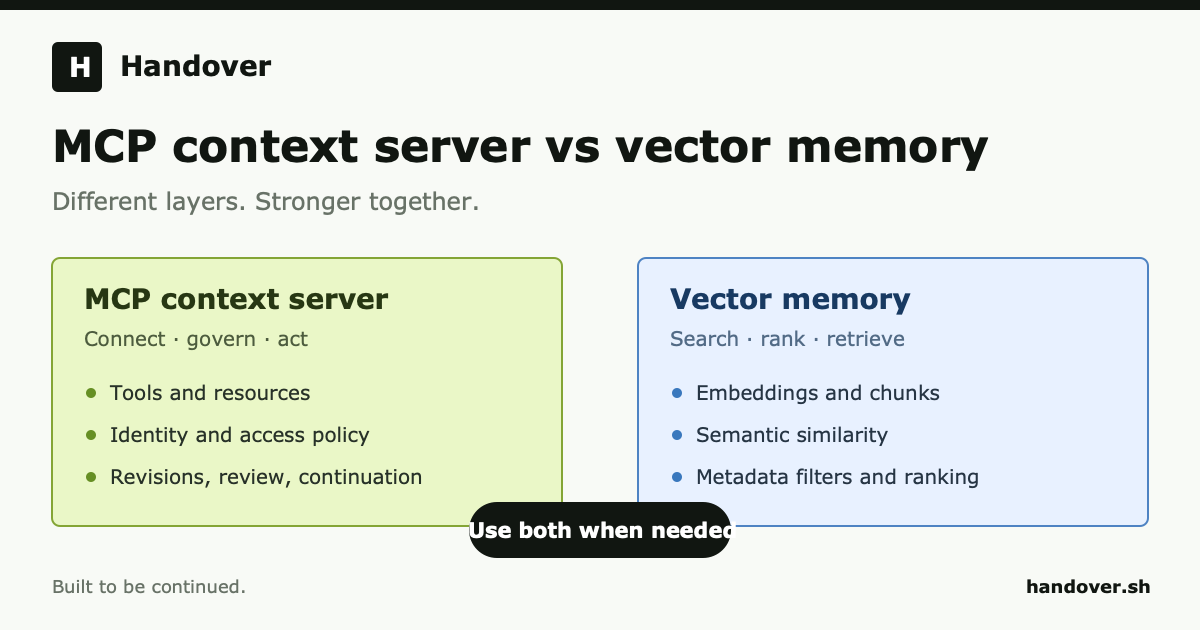
An MCP context server is a program that exposes context and capabilities to compatible AI applications through the Model Context Protocol. It can provide resources for retrieval, tools for actions, and prompts for reusable workflows while the host controls the connection, permissions, and model interaction.
What is vector memory?
Vector memory stores embeddings for content and retrieves chunks that are semantically similar to a query. A vector store can rank results, apply metadata filters, and return matching text, but it does not by itself define authorship, revision history, review state, write operations, or how different AI hosts connect.
What is the practical difference?
Vector search answers which stored passages are likely to be relevant. An MCP server answers which context and actions an AI client can discover and invoke. One is a retrieval implementation; the other is an interoperability boundary that can expose vector search, exact search, files, version history, annotations, and write operations through one governed interface.
- Retrieval: vector memory ranks similar chunks; MCP can expose semantic search, exact search, or direct resource reads.
- Actions: an MCP tool can publish, annotate, resolve, or continue work; a vector query normally retrieves data.
- Portability: MCP gives compatible hosts a common connection and capability model; a vector store remains an implementation behind an API.
- Governance: identity, tenancy, revisions, and approval remain application responsibilities regardless of the vector database used.
When is vector search enough?
Vector search is often enough for read-oriented retrieval over a controlled document collection when approximate semantic matching is the main requirement. It is a good fit for finding passages in manuals, policies, support content, or research notes that do not need a collaborative revision and review workflow.
- The corpus has a clear ingestion and deletion policy.
- Chunk-level retrieval is more important than preserving a whole work package.
- A single application owns authentication, ranking, and user experience.
- Retrieved content does not need comments, assignments, or an immutable history.
When does a team need an MCP context layer?
Use an MCP context layer when work must move between AI clients or authenticated actors, or when retrieval is only one step in a larger continuation workflow. The context layer should preserve the canonical artifact, its revision, evidence, ownership, access policy, and unresolved feedback while exposing safe operations to agents.
- Claude, ChatGPT, Gemini, Cursor, Codex, or custom agents must reach the same record.
- Humans need to inspect and annotate the exact files an agent produced.
- Agents must publish new versions without overwriting concurrent work.
- The company needs named service identities, workspace isolation, and an audit trail.
Should MCP and vector memory be combined?
Yes, when semantic retrieval improves discovery. Keep the durable record and access policy in the context system, index permitted content for semantic search, then expose retrieval and continuation through MCP. Search results should resolve back to the canonical record and immutable revision rather than becoming detached copies.
AI host
  -> MCP client
    -> context server: identity, access, revisions, annotations
      -> exact and metadata search
      -> vector search over permitted content
      -> canonical files and continuation tools
How should a team choose?
Start from the workflow rather than the storage technology. If the requirement is only to retrieve related passages, begin with vector search. If another person or agent must verify, update, comment on, or take ownership of the work, add a durable context system and expose it through MCP. Use both when semantic discovery and accountable continuation are required together.
Primary references