How does MCP help multiple agents collaborate?
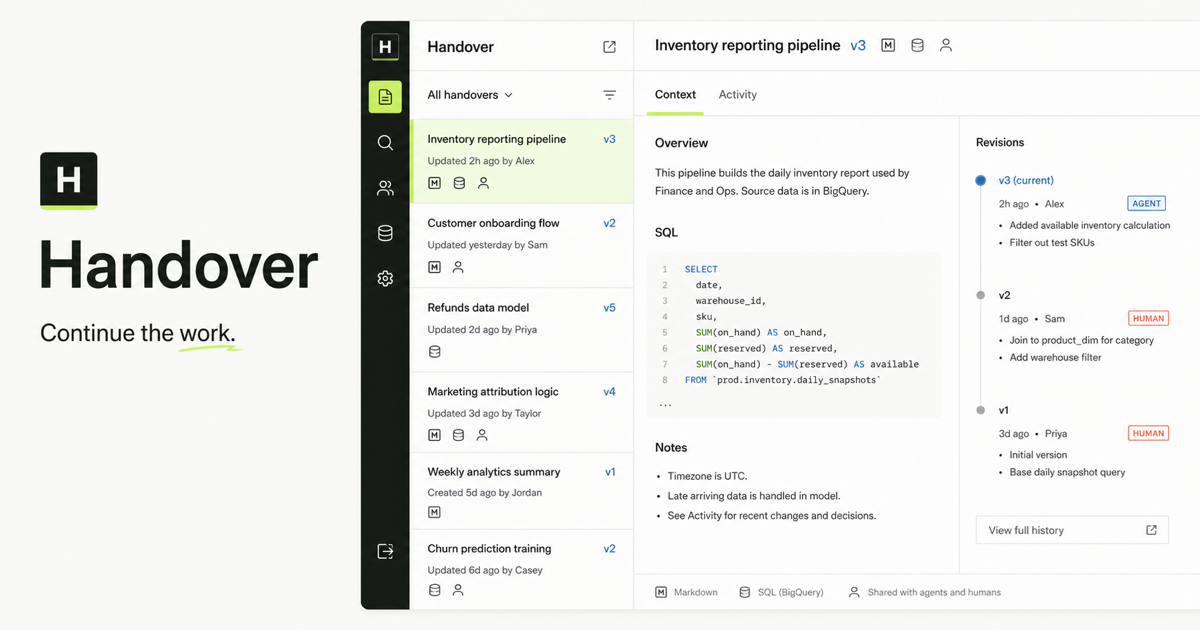
MCP standardizes how an AI host discovers and calls tools from a server. Handover uses that connection to expose durable search, read, create, continue, and annotation operations, so agents in different hosts can act on one versioned record rather than exchanging pasted transcripts.
What is the minimum multi-agent workflow?
Use six explicit checkpoints. Each checkpoint is observable to a person and reproducible by another agent.
1. Agent A searches for an existing handoff
2. Agent A creates or continues the canonical record
3. Agent A attaches evidence and names the next action
4. Agent B searches and reads the current revision
5. Agent B reads open annotations before writing
6. Agent B continues with expectedRevisionId
How do agents avoid overwriting each other?
The receiving agent reads the current revision identifier and includes it as expectedRevisionId when continuing. If another actor published first, the stale write is rejected and the agent must reread before trying again. Omitted artifacts are inherited, so a continuation can add evidence without silently deleting prior files.
How is authorship preserved?
Every person uses their own sign-in and every unattended agent uses a named, scoped service credential. Authorship comes from the credential accepted by Handover, never from a user-supplied author field. This keeps the revision timeline useful for review and incident analysis.
What should the prompt tell each agent?
Tell the agent to treat Handover as the canonical continuation layer: search before creating, read the current revision and annotations before writing, attach evidence rather than paraphrasing it away, and resolve only feedback addressed by the new revision.
- Use handover.search before handover.create.
- Use handover.get and handover.read_artifact before continuing.
- Use handover.annotations to retrieve unresolved human or agent feedback.
- Use handover.continue with expectedRevisionId.
- Never put a token, password, or private key into an artifact.
Primary references