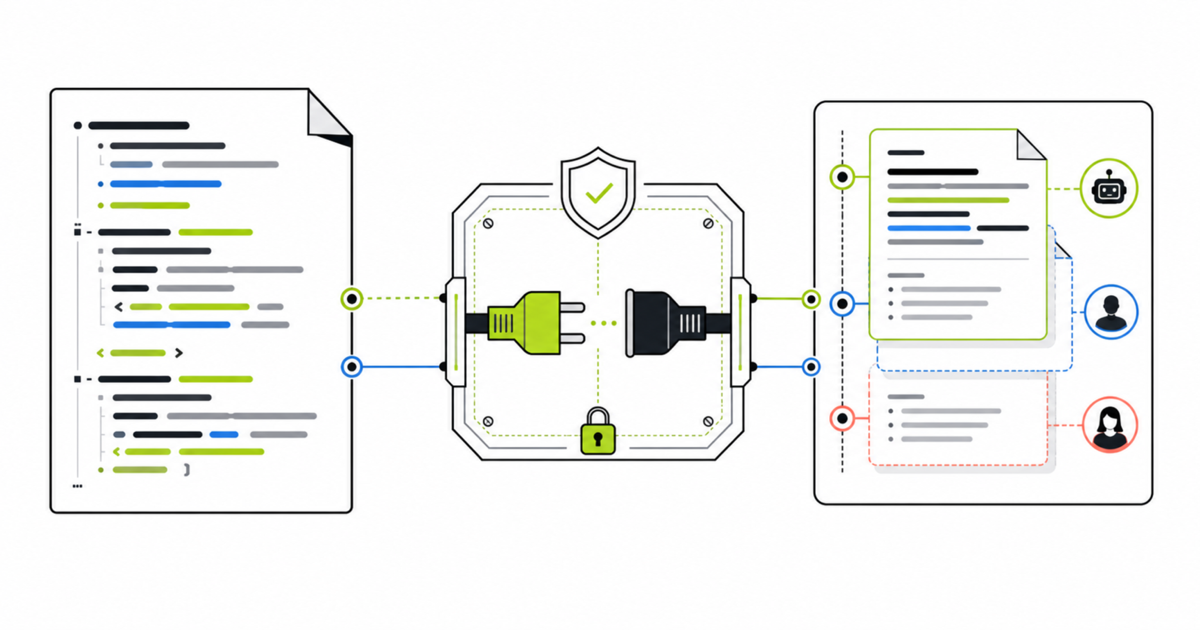
What is an AI agent handoff skill?
An AI agent handoff skill is an installable Agent Skills folder whose SKILL.md contains the triggers and procedure for transferring work to another actor. The open Agent Skills specification requires a name and task-matching description, then allows instructions, scripts, references, and assets to load progressively. For durable continuity, those instructions should create a verifiable work record rather than merely tell the next agent that a transfer happened.
How is a handoff skill different from framework delegation?
Framework delegation changes which agent controls an active run, while a durable handoff skill preserves the work across runs, hosts, models, or people. OpenAI's Agents SDK represents handoffs as tools that transfer a conversation to a selected specialist and states that handoffs stay within one run. A continuity skill can complement that routing boundary by publishing a provider-neutral record before work leaves the current execution context.
Pattern                 Primary boundary              Durable record
Framework handoff       Specialist inside one run     Optional
Agent as tool           Bounded subtask in one run    Optional
Runtime memory          Turns or sessions             Runtime-dependent
AI handoff skill        Model, host, person, or team  Required

Use delegation to choose who acts now.
Use a durable handoff skill when another actor must verify and continue later.
What should the handoff SKILL.md contain?
The handoff SKILL.md should say when to activate, what state to preserve, which authenticated tools to call, which boundaries must remain private, and what evidence proves receipt. Keep credentials outside the skill. Keep stable instructions in SKILL.md, put detailed schemas or checklists in references, and use deterministic scripts only for validation or packaging.
- Triggers: interrupted work, model changes, session limits, owner changes, review, or explicit continuation requests.
- Record: objective, current state, decisions, evidence, constraints, next action, ownership, and open review.
- Identity: verify the server-resolved person or service agent before reading or writing.
- Retrieval: search before creating and read the current revision plus required artifacts.
- Concurrency: continue from the expected current revision instead of overwriting another actor.
- Verification: read the result back and require a separate receiving identity for an end-to-end pass.
How do you install the Handover agent skill?
Inspect the public collection, then install the local-first handoff skill into a compatible host. It creates or resumes a concise HANDOFF.md without requiring Handover, and can publish the same evidence privately when MCP or the CLI is connected. Use the companion handover-record skill when strict machine-readable JSON and schema validation are required.
# Inspect the collection before installing
npx skills add 44-pixels/handover-mcp --list

# Install the local-first handoff skill
npx skills add 44-pixels/handover-mcp   --skill handoff   --copy   --yes

# Read the exact source without installing
https://skills.handover.sh/handoff/SKILL.md
How does the skill use MCP without mixing the layers?
The skill supplies procedure, MCP supplies authenticated tools, and Handover supplies durable storage, authorization, revisions, artifacts, and review. A skill must not claim an identity or organization in prompt text. It asks the MCP server who the actor is, searches within that actor's authorized boundary, publishes privately by default, and verifies the canonical result returned by the server.
1. handover.whoami
2. handover.search
3. handover.get when a canonical record already exists
4. handover.create or handover.continue
5. handover.get and handover.read_artifact
6. handover.annotations before the successor acts

The server resolves identity and access.
The skill never embeds or prints the credential.
How do you test an AI agent handoff skill end to end?
Use two distinct authenticated identities and a unique marker. The publishing agent creates a private handoff with at least one source artifact and reads it back. A fresh successor receives only the stable link or marker, retrieves the same revision, reproduces one meaningful fact from the artifact, states the bounded next action, and appends a new revision with an expected-revision check.
- Format: the skill passes the Agent Skills reference validator.
- Discovery: a natural-language request activates the intended skill.
- Identity: each host reports a distinct expected person or service agent.
- Evidence: the successor reads the exact current artifact, not only a generated summary.
- Continuity: the successor creates an attributable new revision without the first chat.
- Negative path: denied, read-only, stale-revision, and revoked credentials remain denied.
What security rules belong in a handoff skill?
A handoff skill should default to private publication, preserve the authenticated actor supplied by the server, and stop on identity, workspace, scope, or revision mismatches. Mentions and assignments may notify authorized collaborators but must never widen access. Secrets, copied sessions, hidden reasoning, and unrelated transcripts do not belong in the handoff record.
Primary references